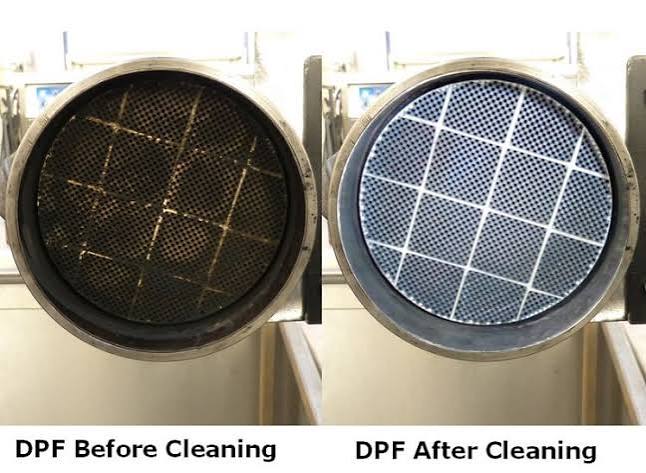
Off-truck cleaning: remove, clean, reinstall
EPA's maintenance guidance describes conventional cleaning this way: the DPF is removed from the vehicle and placed in a cleaning station, where the filter is heated and compressed air with a vacuum system blows the ash out and captures it. The filter then has to be reinstalled in the correct flow direction.
That makes removal and reinstallation part of every job, and the truck is out of service until the filter is back on. EPA notes that fleets concerned about downtime may keep spare filters in stock.
On-truck cleaning: the filter stays installed
With on-truck cleaning, the filter is cleaned in place. Our process combines hydrogen technology with a specialized treatment and is designed to address the soot, ash, carbon, and oil residue that build up in a DPF.
Because nothing comes off, there is no removal or reinstallation, and the work can happen at your yard or at our Upland workshop. Cleaning typically takes 2–3 hours, depending on filter condition.
Side by side
These are the practical differences between the two methods:
| On-truck cleaning | Off-truck cleaning | |
|---|---|---|
| Where it happens | At your location or our workshop | In a shop cleaning station |
| Filter removal | Not needed when the filter's condition allows | Required, followed by reinstallation |
| Truck availability | Our cleaning typically takes 2–3 hours, depending on filter condition | Out of service until the filter is cleaned and reinstalled, unless a spare is used |
| Does not fix | A cracked, melted, or damaged filter | A cracked, melted, or damaged filter |
When removal or replacement is still the answer
No cleaning, on or off the truck, repairs a cracked or melted filter; that calls for replacement. And if the restriction comes from another problem—an injector, oil consumption, a sensor, or regenerations that do not complete—that cause needs attention, or the filter will load up again. EPA notes that a bad fuel injector or increased oil consumption may be masked by a DPF.
Not every filter or condition is suited to cleaning in place. We check first, and if on-truck cleaning is not the right fit, we tell you before starting.
How we decide for your truck
We connect to the truck's computer to read fault codes, review the symptoms and the filter's condition, and confirm whether on-truck cleaning makes sense. When you contact us, share the year, make, model, engine, codes, and location.